Agentic RAG, Graph-R1, MetaRAG and Friends on One Search Engine: What Actually Helps in 2026?
Nine retrieval strategies from 2024-2026 - naive and reranked hybrid search, MetaRAG, agentic RAG, A-RAG, Search-R1, LightRAG and Graph-R1 - benchmarked on the same OpenSearch index, the same generator and the same 1,000 questions. The biggest lever turned out to be the generator's reasoning, not the retrieval architecture.
Agentic RAG, Graph-R1, MetaRAG and Friends on One Search Engine: What Actually Helps in 2026?#
RAG papers each bring their own retriever, corpus split, generator and metric, so their tables don't compose. The practical question is narrower: if my search engine is fixed, which way of asking it questions works best? This post benchmarks nine retrieval strategies published between 2024 and 2026 - from a single hybrid query to RL-trained search agents and knowledge hypergraphs - with everything except the retrieval strategy held constant: one OpenSearch node, one embedding model, one generator, one judge, and the same 1,000 questions over five datasets.
TL;DR - Summary and Recommendations#
Method Selection Guide#
| Situation | Best Choice | Why |
|---|---|---|
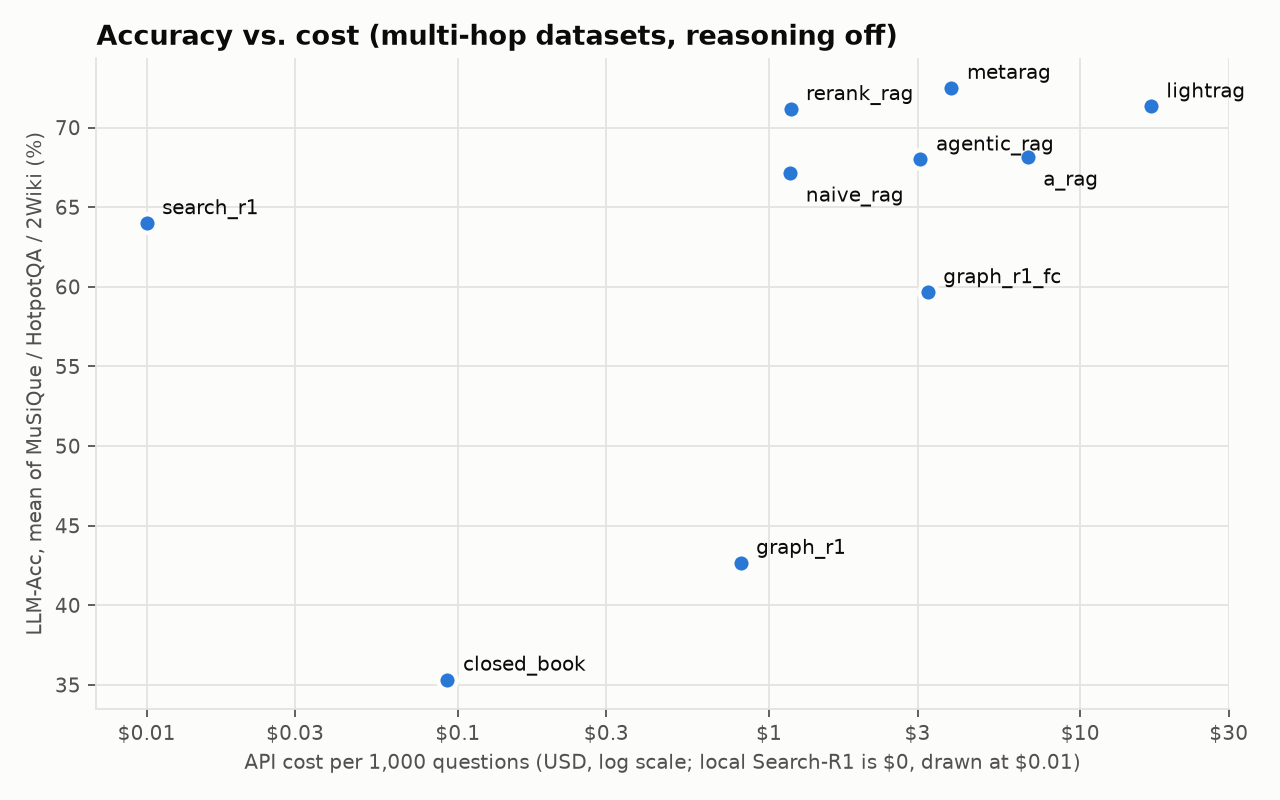
| Cheapest strong baseline | Hybrid search + cross-encoder | 71.2 % multi-hop at $1.26 per 1,000 questions |
| Highest accuracy | Agentic loop + reasoning | A-RAG 86.5 %, simple agent loop 85 % with reasoning_effort="medium" |
| Best accuracy per dollar with reasoning | Naive RAG + reasoning | 78 % at $3.39 per 1,000 questions |
| Generator without reasoning, tricky questions | MetaRAG | Best on 2Wiki (79 %) at 4-6 LLM calls per question |
| Zero API cost | Search-R1 7B (local) | 64 % multi-hop on a MacBook, 1-2 min per question |
| Graph RAG | LightRAG | Top cluster (71.3 %), but 14× the per-query cost of a reranker |
Key Takeaways#
-
Turning on the generator's reasoning moved accuracy more than any retrieval architecture. On the same 200 multi-hop questions,
gpt-5.4-miniwithreasoning_effort="medium"lifted naive RAG from 56 % to 78 % and the agentic loops from ~66 % to 85-86 %. Reasoning also made the agents search more (A-RAG: 2.1 → 6.0 searches per question). -
With reasoning off, nine quite different systems land within a few points of each other. On the multi-hop sets MetaRAG (72.5 %), LightRAG (71.3 %) and plain hybrid search + a cross-encoder (71.2 %) share the top, with the agents (68 %) and one-shot hybrid search (67 %) right behind - differences mostly inside the confidence intervals.
-
The cheapest strong system is boring: OpenSearch hybrid query (BM25 + k-NN, RRF) → local
bge-reranker-v2-m3→ one LLM call. $1.26 per 1,000 questions. LightRAG matches it at 14× the per-query cost plus a ~$20 graph build. -
Graph-R1 is only as good as its RL-trained policy, which is not released. With a prompted policy its think/query loop asks one question and stops (93 % of 2Wiki questions), landing at 43 % on multi-hop vs 67 % for naive RAG.
-
MetaRAG is a reasoning prosthesis: best on 2Wiki with reasoning off (79 %), nearly useless once the model reasons.
-
An RL-trained 7B (Search-R1) on a MacBook reaches 64 % on multi-hop, 4 pp behind
gpt-5.4-mininaive RAG on the same questions (tied on MuSiQue), at $0 API cost and 1-2 minutes per question. -
Check your benchmark first: on GraphRAG-Bench Medical the LLM alone scores 90 %.
Test Environment and Methodology#
Everything except the retrieval strategy is held constant:
- Search engine: one OpenSearch 2.19 node - BM25, Lucene HNSW vectors, the native
hybridquery with an RRF search pipeline, phrase search with highlighting - Embeddings:
bge-base-en-v1.5, running locally - Generator:
gpt-5.4-mini(reasoning_effort="none"for the main runs) - Judge:
gpt-4.1-mini- a different model family, using A-RAG's correct/incorrect rubric - Datasets: the unified datasets released with A-RAG - MuSiQue, HotpotQA, 2WikiMultiHopQA (from the LinearRAG setup), plus GraphRAG-Bench Medical and Novel - each with its own closed corpus, 200 sampled questions each
Where a paper's contribution is how to ask for data - agentic RAG, A-RAG, MetaRAG, Search-R1 - its tools are backed by the same OpenSearch indexes. Only the graph methods build a second index, because that is their idea.
The Contenders#
| Method | Idea | Source |
|---|---|---|
| closed book | the LLM alone | - |
| naive RAG | one hybrid query, top-8 passages | OpenSearch |
| rerank RAG | hybrid top-30 → cross-encoder → top-8 | + bge-reranker-v2-m3 |
| MetaRAG | answer, monitor against an independent expert, critic classifies the error, planner rewrites the query | Zhou et al., WWW'24 (via the SIGIR'26 reproduction) |
| agentic RAG | the LLM calls one search tool in a loop | the pattern from the 2025 agentic RAG survey |
| A-RAG | three tools at different granularity: exact keywords, sentence vectors, full chunk reading | arXiv 2602.03442 (Feb 2026) |
| Search-R1 | 7B model trained with PPO to interleave <think>, <search>, <answer> | Jin et al., 2025 |
| LightRAG | LLM-extracted entity/relation graph, local + global keyword retrieval | HKUDS, lightrag-hku |
| Graph-R1 | n-ary knowledge hypergraph + a think → query → knowledge → answer agent | Luo et al., ICML'26 |
AgenticRAG-R1, which I wanted to include, turned out to be a GRPO training framework without a released checkpoint; Search-R1 represents that family because its weights are public.
Results (Reasoning Off)#
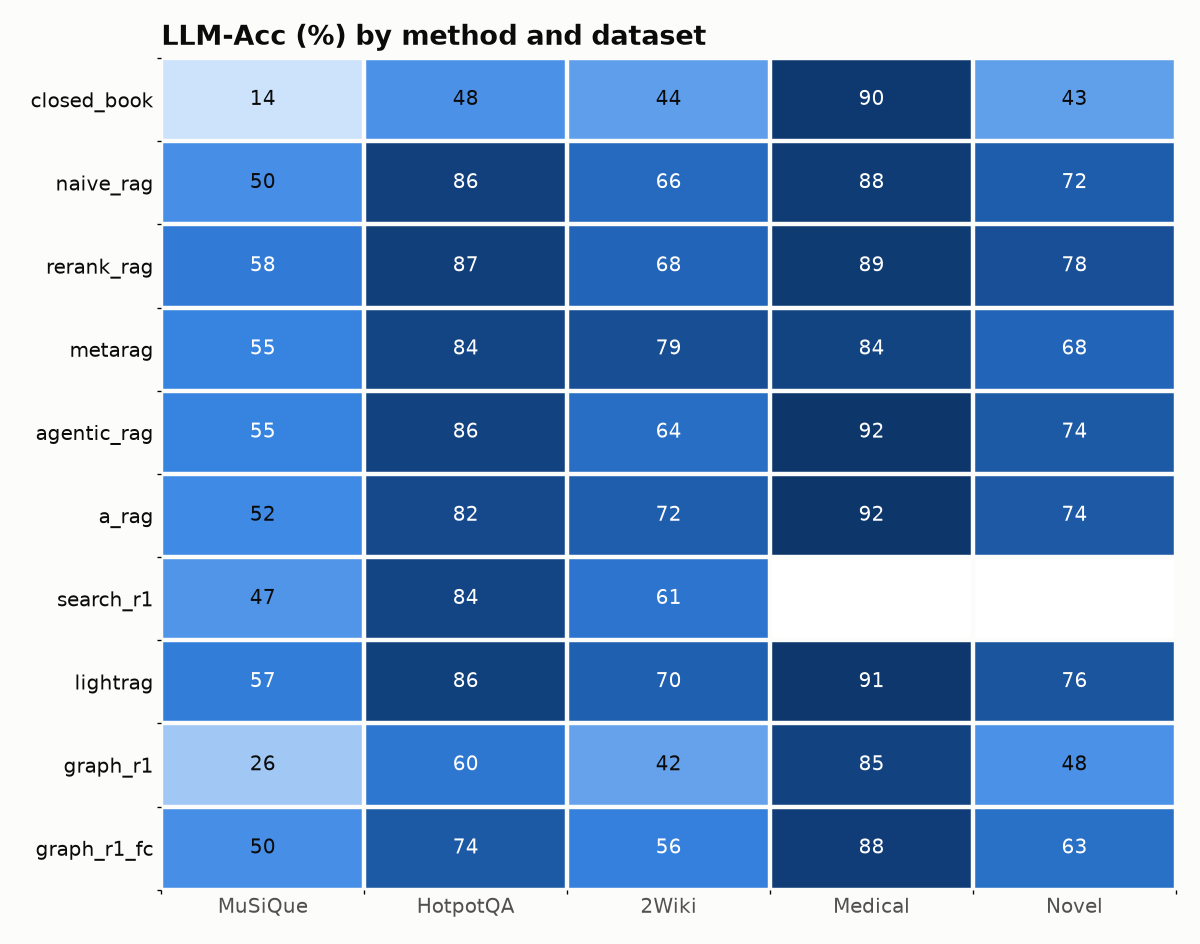
LLM-judged accuracy (%) per dataset (the heatmap also includes graph_r1_fc, the Graph-R1 function-calling ablation from Finding 3). "Multi-hop avg" averages MuSiQue, HotpotQA and 2Wiki.
| Method | MuSiQue | HotpotQA | 2Wiki | Medical | Novel | Multi-hop avg | $ / 1k q |
|---|---|---|---|---|---|---|---|
| closed book | 14.0 | 48.5 | 43.5 | 90.0 | 43.0 | 35.3 | 0.17 |
| naive RAG | 49.5 | 86.5 | 65.5 | 88.5 | 72.0 | 67.2 | 1.25 |
| rerank RAG | 58.0 | 87.0 | 68.5 | 89.0 | 78.5 | 71.2 | 1.26 |
| MetaRAG | 54.5 | 84.0 | 79.0 | 84.5 | 68.0 | 72.5 | 3.14 |
| agentic RAG | 54.5 | 85.5 | 64.0 | 92.0 | 73.5 | 68.0 | 2.71 |
| A-RAG | 51.5 | 81.5 | 71.5 | 91.5 | 74.0 | 68.2 | 6.68 |
| LightRAG | 57.5 | 86.0 | 70.5 | 91.0 | 76.0 | 71.3 | 17.41 + build |
| Graph-R1 (prompted) | 26.0 | 60.0 | 42.0 | 85.0 | 48.5 | 42.7 | 0.84 + build |
| Search-R1 7B (n=100) | 47.0 | 84.0 | 61.0 | - | - | 64.0 | 0 (local) |
95 % bootstrap CIs are roughly ±6-7 pp per cell (the full table with CIs is in the repository README).
Finding 1: The Generator's Reasoning Is the Biggest Lever#
Config: six methods, first 100 MuSiQue + 100 2Wiki questions, reasoning_effort "none" vs "medium"
The main runs use reasoning_effort="none" for every method: gpt-5.4-mini refuses function tools combined with reasoning on Chat Completions, and one setting keeps the methods comparable. This experiment re-runs six methods with "medium" through the Responses API.
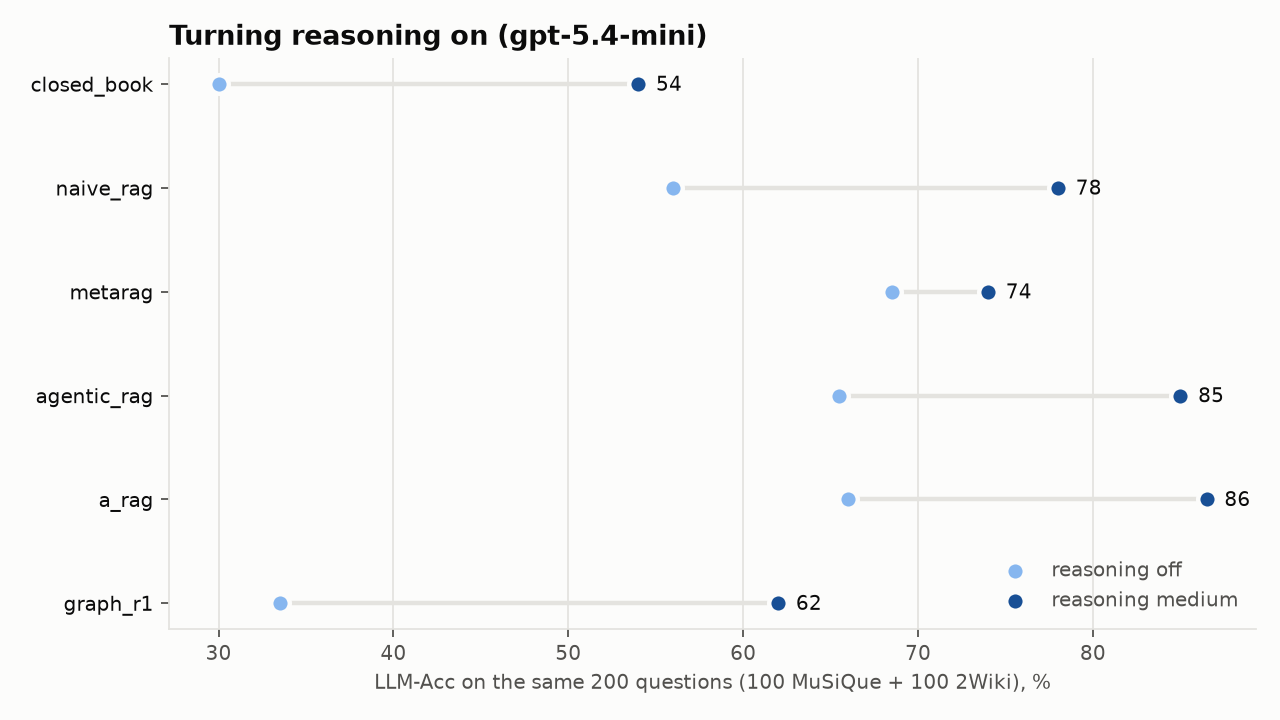
| Method | Reasoning off | Medium | Searches / q (off → medium) | $ / 1k q (off → medium) |
|---|---|---|---|---|
| closed book | 30.0 | 54.0 | - | 0.10 → 8.57 |
| naive RAG | 56.0 | 78.0 | 1 → 1 | 1.17 → 3.39 |
| MetaRAG | 68.5 | 74.0 | 1.3 → 1.2 | 3.86 → 7.99 |
| agentic RAG | 65.5 | 85.0 | 2.4 → 4.1 | 3.32 → 10.07 |
| A-RAG | 66.0 | 86.5 | 2.1 → 6.0 | 6.96 → 19.65 |
| Graph-R1 | 33.5 | 62.0 | 1.8 → 2.2 | 0.85 → 7.25 |
Analysis#
The agents stop making answer-type mistakes. With reasoning off, asked "Which film has the director who died earlier, X or Y?", they often search correctly and then answer with the director's name.
They explore more. A-RAG triples its searches. A simple one-tool agent loop goes from 70 % to 94 % on 2Wiki.
Reasoning is not free. A-RAG goes from $7 to $20 per 1,000 questions. Naive RAG with reasoning ($3.4) is the cost-efficient point if you can live with 78 %.
Finding 2: MetaRAG Is a Reasoning Prosthesis#
MetaRAG checks its own answers: an independent "expert" answers too; if the two disagree, a critic classifies the error ("the question asks whose residence, not which building") and a planner rewrites the query.
With reasoning off, this is the best method on 2Wiki (79 % vs 65.5 % naive), at 4-6 LLM calls per question. With reasoning on, it adds almost nothing (68.5 → 74 %) and ends below naive RAG with reasoning (78 %): the model now does that checking itself.
Finding 3: Graphs - LightRAG Is Solid but Heavy, Graph-R1 Needs Its Policy#
LightRAG is in the top cluster (71.3 % multi-hop) and has the best context recall of any method (82.5 % of short answers appear in its context), but its default context is ~23k tokens per question: $17.4 per 1,000 questions, 14× naive RAG, plus ~$20 of gpt-4o-mini to build graphs for the five corpora. A reranker gets the same accuracy for the price of naive RAG.
Graph-R1 builds a hypergraph of "knowledge segments" (n-ary facts as sentences, $8.4 for all five corpora) and lets an agent query it. Its authors train that agent with GRPO; without the weights the policy here is the prompted generator, and it collapses: one query for 93 % of 2Wiki questions, 42.7 % on multi-hop.
An ablation gives the same hypergraph to the function-calling loop of agentic_rag: 3× the queries and +17 pp (59.7 %), still below plain passage retrieval, because rewritten facts drop details that raw passages keep (context recall 59 % vs 65-83 %). Reasoning helps it most of all (+28 pp), but even then it issues about one query. Graph-R1's index is only as good as the policy that explores it, which is exactly what its own RL ablation says.
Finding 4: An RL-Trained 7B on a Laptop#
Config: Search-R1 (Qwen2.5-7B trained with PPO on NQ + HotpotQA), Q4_K_M GGUF on llama.cpp / Metal, same OpenSearch hybrid retriever through its <search> tags, top-3 passages per search, greedy decoding
| Method | MuSiQue | HotpotQA | 2Wiki | Multi-hop |
|---|---|---|---|---|
| Search-R1 7B | 47 | 84 | 61 | 64.0 |
naive RAG, gpt-5.4-mini, same 100 questions | 47 | 91 | 65 | 67.7 |
Analysis#
It searches ~3 times per question (2.6-3.2) and its contexts contain the answer 73.7 % of the time, the same as the frontier-model agentic_rag loop (73.5 %): the RL-trained policy decides when and what to search as well as a much larger prompted model; it loses on reading.
HotpotQA, which it was trained on, is its best dataset. It is the only method with zero API cost, and the slowest: 70-100 s median per question on an M3 that was also running other jobs.
Finding 5: Benchmark Hygiene#
- Medical (GraphRAG-Bench) is saturated: closed book 90 %, every method 84-92 %. It measures medical knowledge, not retrieval.
- MuSiQue is the discriminating dataset: closed book 14 %, best non-reasoning method 58 %, best reasoning one 81 %.
- The LLM judge is lenient on near misses ("early 1980s" accepted for "1981"). EM / F1 / Contain are reported next to it for the short-answer sets; they reorder methods inside the top cluster but agree on who is in it (reranked hybrid, MetaRAG, LightRAG) and on the bottom (closed book, prompted Graph-R1).
Engineering Notes (Things That Cost Hours)#
-
gpt-5.4-mini+ function tools + reasoning is rejected on/v1/chat/completionsfor anyreasoning_effortother than"none". Use/v1/responsesand replay the encrypted reasoning items between tool turns (include=["reasoning.encrypted_content"],store=False). -
Embedding speed on Apple Silicon.
Qwen3-Embedding-0.6B(A-RAG's choice) embedded ~5 passages/s on an M3 via MPS;bge-base-en-v1.5~50/s. -
LightRAG indexing slows quadratically with its default file storages, because it commits every store after every document. Insert many corpus chunks per LightRAG document, micro-batch its embedding calls, and check for FAILED documents afterwards: they are not retried, and an interrupted build can leave one that cannot be repaired.
-
OpenSearch's
hybridquery +score-ranker-processor(RRF) pipeline is a few lines of JSON and was the most valuable single component in the study.
Limitations#
- One generator family and one run per configuration; at n = 200, differences under ~5 pp are noise.
- Graph-R1 and AgenticRAG-R1 are evaluated without their RL-trained policies (none released).
- Search-R1 runs a 4-bit checkpoint on 100 questions per multi-hop dataset, with this benchmark's retriever instead of the E5 + Wikipedia setup it was trained against, and is not evaluated on the long-answer sets.
- MetaRAG's T5 helper models are replaced by
gpt-5.4-nano; LightRAG's MuSiQue graph misses 4.7 % of the corpus.
Reproducing These Results#
All method implementations, run scripts, raw per-question results and figures are available in the accompanying repository. Total API spend for everything in this post: ≈ $80.
# 1. search engine
docker compose up -d                       # OpenSearch on :9200

# 2. python env + data
uv sync
python scripts/download_data.py
export OPENAI_API_KEY=...

# 3. indexes (embeddings run locally; graph builds call gpt-4o-mini)
uv run ragbench index
uv run ragbench index --method graph_r1
uv run ragbench index --method lightrag

# 4. run + report (search_r1 needs a local llama-server, see the README)
uv run ragbench run --methods closed_book naive_rag rerank_rag metarag agentic_rag a_rag graph_r1 lightrag search_r1 -n 200
uv run ragbench report                     # -> results/summary.md, results/*.csv, results/figures/*.png
Runs are resumable (one JSONL line per question in results/runs/<dataset>/<method>.jsonl) and every LLM response is cached, so re-running costs nothing. The raw JSONL files contain the prediction, every metric, token usage and the full retrieval trace for each question - far more detail than the tables here.
If you run into questions or issues while reproducing these results, please open an issue on GitHub.